
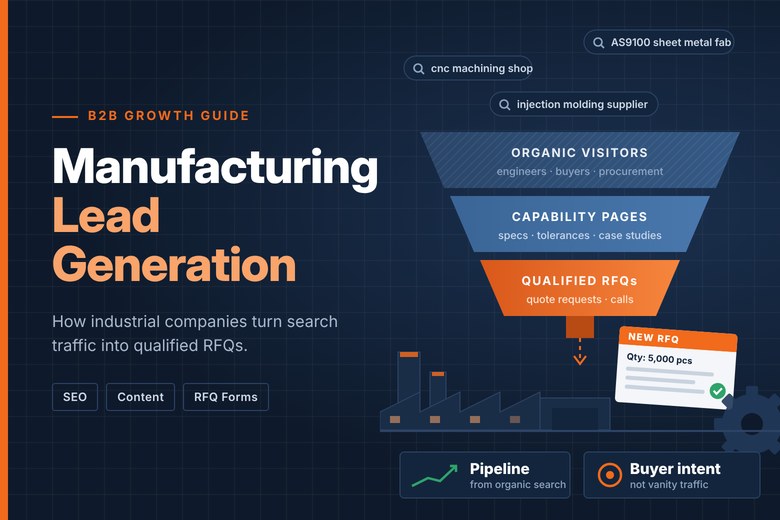
Ask a manufacturer how lead generation is going and you’ll usually hear one of two complaints. Either there aren’t enough inquiries, or there are plenty of them and most go nowhere: students, job seekers, distributors fishing for a price list, a buyer who wanted 50 pieces by Friday.
Lead generation companies tend to answer both complaints the same way, with more leads. But for most small and mid-sized manufacturers, the real problem sits on either side of that number. The leads come from sources that don’t match how industrial buyers actually choose suppliers, or good leads arrive and wait too long for an answer.
This guide looks at both. First, an honest comparison of where manufacturing leads come from and what each source is good for. Then what to do in the hours and weeks after an inquiry lands, which is where most manufacturers lose more business than they realize.
The short answer
- Not all leads are equal. An RFQ with a drawing, a quantity and a deadline is worth more than a hundred newsletter signups. Decide what a qualified lead means before you buy, chase or count anything.
- Use more than one source. Outbound and paid sources can start conversations quickly. Search, referrals and reputation bring buyers who already want what you make, and they keep working after you stop paying.
- Answer fast. The first supplier to respond to a serious inquiry has a real advantage.
- Measure by source. Track cost per qualified RFQ and per won job, not cost per lead.
What counts as a lead in manufacturing
In most industries a “lead” is any name and email address. That definition causes trouble in manufacturing, where one good RFQ can be worth more than a year of form fills.
A useful working definition: a qualified lead is a real company with a part or project you can make, a rough quantity, a timeline, and a person involved in the decision. Everything else is either an early-stage contact worth nurturing or noise.
It also helps to remember that a single purchase usually involves several people. The engineer who found you, a buyer in procurement, a quality manager checking your certifications and sometimes an executive signing off. A lead from the engineer is the start of a conversation with a committee, not a sale.
Where manufacturing leads come from
Here’s how the common sources compare:
| Source | What you get | How you usually pay | Best for |
|---|---|---|---|
| Bought contact lists | Names and emails of people who never asked to hear from you | Per list or subscription | Supporting an outbound team that already knows its target accounts |
| Outbound agencies | Booked meetings from cold calls, email and LinkedIn | Monthly retainer, per meeting or both | Opening doors with specific large accounts |
| Industrial directories and marketplaces | Buyers browsing a supplier platform | Annual listing or advertising package | Being present where some buyers already shortlist suppliers |
| Trade shows | Face-to-face conversations with an industry | Booth, travel and staff time | Relationships in a defined niche |
| Reach to specific job titles and companies | Ads, or your team’s time | Targeting known accounts and roles | |
| Google Ads | Searchers looking for a process or part right now | Per click | Filling the pipeline quickly for high-intent searches |
| Search (SEO) | Buyers who found your capability pages on their own | Time and content, no per-click cost | Steady, high-intent RFQs that compound over time |
| Referrals, reps and distributors | Introductions from people who know you | Commission or goodwill | Trust that’s hard to buy any other way |
Bought lists and outbound agencies
Contact databases and outbound agencies can put you in front of companies you’d never reach otherwise, and for a manufacturer targeting a short list of large OEMs, that can be worth it. The catch is that you’re interrupting people who weren’t looking for you. Expect a lot of outreach for each real conversation.
Some agencies now sell “intent data”: signals that a company has been reading about a topic online, such as precision machining or a particular alloy. It can help with timing, but ask where the data comes from and how recent it is.
Whoever runs the outreach, your company’s reputation is attached to every email sent in your name (there’s a checklist for vetting agencies near the end of this guide). Cold email to businesses is legal in the US, but it has to follow the CAN-SPAM Act, which has no exemption for business-to-business email: accurate sender details, an honest subject line, a valid postal address and an opt-out that’s honored within 10 business days, as the FTC’s compliance guide explains. Hiring an agency doesn’t move that responsibility off you.
Directories, marketplaces and trade shows
Supplier directories and on-demand manufacturing marketplaces sit between outbound and search. Buyers do use them, but you’re listed next to your competitors, often compared on price. We looked at the biggest one in detail in is Thomasnet worth it?
Trade shows still matter in industries built on relationships. IMTS and FABTECH draw huge crowds of buyers and engineers in Chicago and other host cities, and the Offshore Technology Conference does the same for energy equipment in Houston. The weak spot is almost always the follow-up. Badge scans that sit in a spreadsheet for three weeks are an expensive way to collect business cards.
LinkedIn and Google Ads
LinkedIn is usually the most precise paid channel for reaching specific job titles at specific companies, which suits account-based selling. Google Ads reach people at the moment they search for a process or part, so the intent is higher, but every click costs money and the leads stop when the budget does. Our post on Google Ads for manufacturers covers when paid search pays off.
Search
Search works differently from everything above. Nobody is interrupted and nobody is paid per click. An engineer searching “titanium CNC machining AS9100” or “custom aluminum extrusion supplier” already has a project, and if your capability page answers their question, the inquiry often arrives with a drawing attached.
The trade-off is time. Good rankings take months to build. But they compound: the page that brought in an RFQ this month keeps doing it next year, and buyers increasingly check search, and AI tools like ChatGPT, before they ever talk to a salesperson.
Our manufacturing SEO services are built around this kind of inbound demand, from industrial SEO and B2B SEO to the technical work underneath it. If you’re not sure what that work involves, our guide to what manufacturing SEO services include breaks it down.
Referrals, reps, distributors and partners
For many manufacturers, the best leads still come from existing customers, independent reps and distributors. They’re not something you can switch on, but you can make them easier: a clear capabilities summary reps can forward, case studies they can share, and a website that confirms what they’ve told the buyer.
Partners can open doors too. A joint webinar or technical session with a material supplier, equipment maker or distributor puts you in front of their customers, and they get useful content for their audience in return.
Which mix makes sense
There’s no single right answer, but a few patterns hold up:
- A small job shop or fabricator usually gets the most from local search, referrals and a few industry directories. Our machine shop marketing guide covers that in detail, and our service areas page shows the manufacturing regions where we do most of this local work.
- A specialized manufacturer selling nationally does well with search and content around its processes, materials and certifications, supported by one or two trade shows.
- A supplier chasing a short list of big OEMs may need outbound and LinkedIn to get the first meeting, with search and a strong website doing the convincing afterwards.
Whatever the mix, the buyer will look you up before replying. If your website doesn’t back up what your outreach or your rep promised, the lead goes cold.
What happens after a lead arrives
This is where most manufacturers lose the business they paid to attract. A study published in Harvard Business Review in 2011 tested how quickly 2,241 US companies responded to an inquiry submitted through their website.
Only 37% replied within an hour, and 23% never replied at all. A separate analysis in the same article found that companies contacting a lead within an hour were nearly seven times as likely to qualify it as those that waited even an hour longer.
Sales trainers go further and talk about a “five-minute rule.” In manufacturing, you can’t send a quote in five minutes, but you can respond quickly. A practical standard:
- Within minutes: an automatic confirmation that says what happens next, who will reply and by when.
- Within the hour, during business hours: a real person acknowledges the inquiry and asks any missing questions.
- Within the promised time: the quote, or an honest update if engineering needs longer.
Get the lead to the right person
Many inquiries die in a shared inbox. Decide who owns each type of inquiry: RFQs with drawings to estimating, general questions to sales, supplier and job inquiries somewhere else entirely. Route them automatically if your form or CRM allows it.
It also helps if whoever handles marketing and whoever writes quotes agree on what a good lead looks like. Ten minutes a week reviewing last week’s inquiries together settles most “these leads are junk” arguments, and it shows which pages and channels bring the right ones.
Ask the few questions that matter
Qualify quickly and politely. The questions that sort real projects from the rest are simple: what’s the part or project, what material, roughly how many and how often, when is it needed, and what certifications or inspections apply. If your RFQ form already asks these, even better. We covered how to build a form engineers actually finish in our posts on manufacturing website design and manufacturing marketing, so we won’t repeat it here.
Follow up on every quote
Plenty of quotes go out and are never followed up. Call or email a few days after sending one, and again before it expires. Record why you lost the ones you lose (price, lead time, capability, no response). Over a year, that list tells you more about your market than any lead report.
Stay in touch with buyers who aren’t ready yet
Industrial buying cycles are long, and many engineers prefer to research suppliers on their own until they’ve drawn up a shortlist. An engineer who reads your design guide this month may not have a project until next year. Give those people a reason to remember you:
- Keep spec sheets, capability summaries and certifications open to everyone. Engineers dislike filling in a form just to read a tolerance table.
- Reserve sign-up forms for genuinely substantial resources, like a design-for-manufacturing guide or a material selection handbook.
- If you make standard or configurable parts, offer CAD models. A download usually means an engineer is designing your part into something, which makes it one of the strongest early signals you can get. A short form (name, company, email) before the download is reasonable.
- Post short videos of real parts being made. A minute of a machine cutting a tight-tolerance feature says more than a paragraph of claims, on your capability pages, YouTube and LinkedIn alike.
- Send a short, useful email every month or two: a new capability, a case study, a design tip. Make unsubscribing easy.
Content like this also ranks in search and gets cited in AI answers, which is why it’s a core part of our content marketing work. Our post on how manufacturers get found in AI search explains why clear technical pages matter more than ever.
Measure what each source is worth
Cost per lead is the most misleading number in manufacturing marketing. A source that produces 200 cheap leads and no orders is more expensive than one that produces five RFQs and two contracts.
Track, for every lead: where it came from, whether it qualified, whether you quoted, and whether you won. A spreadsheet works; a CRM works better. After six to twelve months, compare sources on:
- Cost per qualified RFQ
- Quote-to-win rate
- Average order value and repeat business
- Cost per won customer
You’ll usually find one or two sources doing most of the work. Put more into those, and fix or drop the rest. If your website is converting visitors poorly, our website optimization service is the place to start, and link building helps the pages that convert rank higher.
How to choose a lead generation company
If you decide to bring in outside help, ask these before you sign:
- How exactly do you define a lead or a booked meeting?
- Who will you contact in our name, and can we approve the messaging?
- Can we hear call recordings and see email replies?
- If you use intent data, where does it come from?
- Are leads exclusive to us?
- What does it cost per qualified opportunity, not per contact?
- What happens if the leads don’t convert? What are the cancellation terms?
An agency that can’t answer clearly is selling volume, not results. The same questions apply to SEO firms; our guide to choosing a manufacturing SEO agency has more.
Want more RFQs from buyers who are already looking? Talk to us about what you make and who buys it. We’ll show you where your next qualified leads are likely to come from.
Frequently Asked Questions
Finding and attracting companies that need what you make, and turning their interest into conversations and quotes. It covers outbound methods like cold outreach and inbound ones like search, plus how inquiries are handled once they arrive.
It depends on the source and what a customer is worth to you. Agencies charge retainers, per-meeting fees or both, and paid search charges per click. Compare options on cost per qualified RFQ and per won customer rather than on the price of a lead.
Slow or inconsistent follow-up. Many manufacturers spend heavily to generate inquiries, then let them wait days for a reply, or never follow up on the quotes they send.
The idea that responding within minutes greatly improves your chances of turning an inquiry into a conversation. It comes from research on sales response times. In manufacturing, an instant confirmation and a personal reply within the hour is a realistic version of it.
In the US, yes, as long as you follow the CAN-SPAM Act: honest sender details and subject lines, a valid postal address and a working opt-out honored within 10 business days. Other countries have stricter rules, so check before emailing contacts abroad.
If you sell to many companies who search for your processes, start with inbound: your website and search. If you sell to a handful of large OEMs, outbound can open doors faster, but you’ll still need a website that convinces them once they look you up.
Usually a few months for the first inquiries from new pages, and longer for competitive processes. Unlike paid sources, the results keep building once the pages rank.

Skyler Lyon
Skyler is a B2B growth expert with over a decade of experience building and managing high-growth SEO programs for manufacturing companies.